

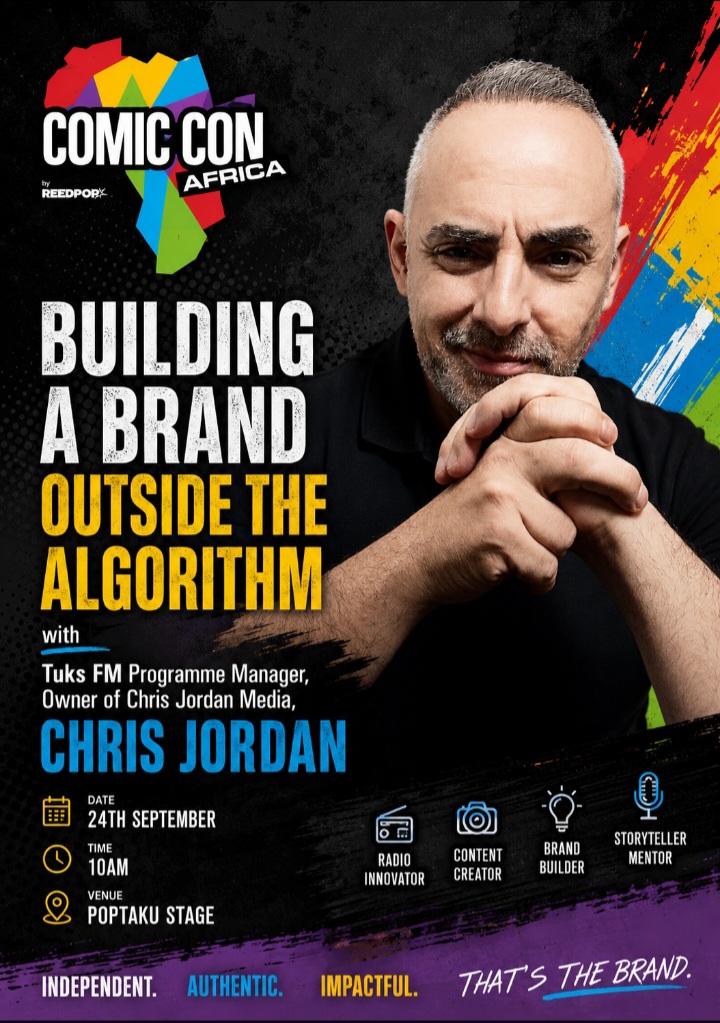
At Comic Con Africa 2026, the masterclass Beyond Followers opened with a stark question:
If Instagram, TikTok, YouTube and Twitch disappeared tomorrow… who would you be?
Most creators freeze. Their identity, reach and income live on rented platforms. The session’s core message was simple and urgent: Don’t build an account. Build a reputation. Don’t chase followers. Build a community. Don’t build for an algorithm. Build something people will look for.
This post expands that core with current research, hard stats, case studies and practical applications so you can turn the stage talk into an owned-audience strategy.
The Algorithm Trap: Why Follower Counts Are Fragile
The creator economy is large but brutally unequal. In 2026 estimates place it between roughly $250–325 billion (narrow definition) and higher when broader ecosystem spending is included, with projections toward $480 billion by 2027 and further growth beyond. Yet nearly half of creators earn under $10,000 a year; the median sits around $3,000 while the average is skewed dramatically higher by a small elite. The top 10% capture the majority of brand payments.
Algorithm dependency makes this worse. Creators report high burnout (often 50–70%+ in surveys), financial insecurity, and obsession with metrics. Platform updates can slash reach overnight — one documented case saw a fitness creator’s monthly views drop 60% and income fall from $8,000 to $3,200 after a YouTube algorithm change.
Follower count itself is losing power with brands. Suitability and brand fit now rank far above raw numbers; follower count often sits near the bottom of decision factors. Many creators with large followings still feel tension between audience desires and brand demands.
The practical takeaway from the session (and the data): treat social platforms as discovery and top-of-funnel only. Your real asset is the relationship you own.
Core Framework: Content ≠ Brand, Personal Brand + Media Brand
Content is what you make. Brand is what people remember.
Your logo, follower count and current platform are not your brand.
Distinguish and deliberately build both:
- Personal brand: Identity, point of view, personality, trust.
- Media brand: Promise, format, community, scalability.
The opportunity is to build both so a single idea can travel across experiences: a provocative TikTok hook, an Instagram visual explainer, a YouTube deep dive, a podcast conversation, a LinkedIn analysis, a live event, an email sequence or a community space.
Apply the 3-second test to your profile and content: Would a stranger instantly know what you do, who you serve, and why they should return? If not, fix the brand before blaming the algorithm.
Watch this complementary perspective:
Why You Must Build a Personal Brand – Daniel Priestley
A clear, practical case for treating your personal brand as a long-term asset rather than a platform metric. It aligns directly with the Beyond Followers message.
Case Studies: Creators Who Built Outside Pure Algorithm Dependence
James Clear built an email list of hundreds of thousands (later millions) through consistent, high-value long-form writing long before Atomic Habits. That owned list helped secure the book deal and continues to power a multi-million-dollar newsletter business. Social platforms amplified; the list compounded and converted.
Melissa Wood (Melissa Wood Health) grew on Instagram and a popular fitness app, then deliberately moved her community onto her own platform. She converted thousands of subscribers on launch day, gaining control and protecting against platform risk while maintaining high email open rates.
Whitney Manney shifted focus from algorithm-dependent social reach to a newsletter with ~40% open rates (roughly double typical benchmarks). She treats email as the place she owns the conversation and sales funnel.
These creators still use platforms, but they treat them as rented real estate. The durable assets are the email list, the community, the proprietary format, and the reputation that makes people seek them out.
Practical Applications & Concrete Implementation Steps
Here is exactly how to turn the Beyond Followers framework into action.
Step 1: Run the 60-Second Brand Challenge (Do this today)
Set a timer for 60 seconds and complete these six statements in writing:
- I am…
- I create…
- I help…
- I believe…
- I am different because…
- Find me at…
Refine the answers until they fit into a clear 20-second spoken pitch. Record yourself saying it. Post the pitch (or the written version) and tag the event or relevant people. This becomes your core positioning statement.
Step 2: Apply the 3-Second Test to Your Profiles (This week)
Open every public profile (Instagram, TikTok, YouTube, LinkedIn, X, website). Look at each one for only three seconds and answer:
- What do I do?
- Who do I do it for?
- Why should someone come back?
Rewrite bios, pinned posts, and about sections until a complete stranger can answer all three questions immediately. Prioritise LinkedIn and your main content platform first.
Step 3: Map One Live Brand Example (This week)
Take this approach:
Content → Personality → Niche → Audience → Positioning
Write it out in one sentence, e.g.:
“Gaming content delivered with a funny + competitive personality, focused on competitive gaming for young African gamers.”
Use this map to guide your next 7–14 pieces of content.
Step 4: Build Your Owned-Audience Foundation (Start this week, complete in 14 days)
- Choose one email tool (Beehiiv, ConvertKit, Substack, Mailchimp, etc.).
- Create a simple lead magnet (PDF checklist, short guide, template, or the 60-second brand challenge worksheet).
- Add a clear signup form to your bio links, website, and pinned posts.
- Commit to sending one valuable email per week for the next 8 weeks.
- Aim for a realistic first goal: 100–300 engaged subscribers.
Step 5: Create One Idea Across Multiple Formats (Ongoing)
Take one strong idea and deliberately adapt it:
- TikTok / Reels / Shorts → 30–60 second provocative hook
- Instagram → carousel or visual explainer
- YouTube → 8–15 minute deep dive
- Podcast / LinkedIn audio → longer conversation or analysis
- Email / Newsletter → practical takeaway + call to action
Schedule the adaptations rather than posting the same thing everywhere.
Step 6: Establish Professional Standards (Immediate and continuous)
Treat your creator work like a professional service:
- Deliver on time
- Communicate clearly
- Collaborate cleanly
- Stay consistent even when metrics dip
- Keep ethical boundaries
These traits make you hireable and referable long after any single platform changes.
Step 7: Weekly Review Ritual (Every Sunday)
Ask yourself:
- Did I move people from rented platforms toward owned channels this week?
- Did my content pass the 3-second test?
- What is the single most important relationship or asset I strengthened?
Adjust next week’s plan accordingly.
Complementary Resources
- Video: Why You Must Build a Personal Brand – Daniel Priestley (embedded above).
- AI-assisted exploration: Google AI Mode conversation – related ideas and research threads around building durable brands beyond algorithms.
- Re-watch or review the original Beyond Followers masterclass notes from Comic Con Africa 2026 for the interactive energy and live brand-building exercises.
Here’s a clear, practical investigation of community platform alternatives for creators who want to own their audience (aligned with the Beyond Followers principle of building outside pure algorithm dependence).
Quick Recommendation Matrix (2026)
| Platform | Best For | Starting Price | Transaction Fees | Strengths | Weaknesses | Ownership Level |
|---|---|---|---|---|---|---|
| Skool | Most solo creators & coaches | $9–$99/mo | 10% (Hobby) → 2.9% (Pro) | Extremely simple, strong gamification, courses + community in one, discovery directory | Limited branding/customisation | Medium |
| Circle | Polished, multi-space brands | ~$89/mo | 0.5–2% | Flexible spaces, good course tools, clean UX, strong integrations | Higher starting cost | Medium-High |
| Mighty Networks | Course + community hybrids | ~$41–$79/mo | 0.5–3% | Native mobile apps, events, cohorts | Steeper learning curve | Medium-High |
| Discord | Free real-time chat communities | Free | Via 3rd-party | Real-time chat, voice, massive reach, free | Weak for paid/structured content, algorithm/noise risk | Low |
| WhatsApp / Telegram | Simple, high-trust local groups | Free | None | Extremely high open rates, mobile-native, familiar in Africa | Limited structure, scaling issues | High (group control) |
| WordPress + BuddyBoss / BuddyPress | Full ownership & SEO | Hosting + ~$99/yr | 0% | Complete data ownership, SEO, unlimited customisation | Requires more technical setup | Highest |
Detailed Breakdown
1. Skool (Current default recommendation for most creators)
- Best starting point for solo creators, coaches, and educators in 2026.
- Combines community feed + basic courses + events + strong gamification (levels, leaderboards) that drives retention.
- Very fast to launch. Flat pricing on higher plan reduces fee anxiety.
- Has a public discovery directory that can bring organic members.
- Limitation: Deliberately simple — little branding control.
2. Circle
- Strong alternative when you need more structure (multiple spaces/groups), better branding, or deeper course features.
- Used by established creators who want a more “premium” member experience.
- Higher monthly cost but lower transaction fees than Skool Hobby.
3. Mighty Networks
- Excellent if mobile app experience and live events/cohorts are central.
- Good for creators who want courses + community + events under one roof.
- More configuration options (and complexity) than Skool.
4. Discord
- Still the king of free, real-time, high-energy chat.
- Ideal as a free top-of-funnel or secondary community layer.
- Poor native monetisation and weak long-term content organisation. Many creators use Discord for free hangouts and move serious members to Skool/Circle.
5. WhatsApp / Telegram Groups
- Extremely practical for African creators and tight-knit communities.
- Highest attention rates of almost any platform.
- Best used for smaller, high-trust groups (alumni, mastermind, VIP). Pair with a more structured platform (Skool/Circle) for larger paid communities.
6. Self-hosted (WordPress + BuddyBoss / BuddyPress)
- Maximum ownership and long-term control.
- Best when you already have a website and care about SEO + full data ownership.
- Higher setup and maintenance cost.
Decision Guide for Beyond Followers Creators
- Just starting / want maximum simplicity and speed → Start with Skool (Hobby plan if testing, upgrade to Pro once revenue is consistent).
- Want polished branding + multiple spaces → Circle.
- Heavy on courses + live events + mobile app → Mighty Networks.
- Need free real-time energy → Keep Discord or WhatsApp/Telegram as a free layer.
- Want complete ownership and SEO → Move to WordPress + BuddyBoss once the community is proven.
Practical Next Steps
- Decide your primary use case (paid membership, free community, course + discussion, local high-trust group).
- Test 1–2 platforms with a small group of your existing audience for 2–4 weeks.
- Always drive people from social platforms → owned community → email list.
- Measure what matters: active members, retention, conversations started by members (not just your posts), and revenue if paid.
